FORAGER-ON-THE-GO
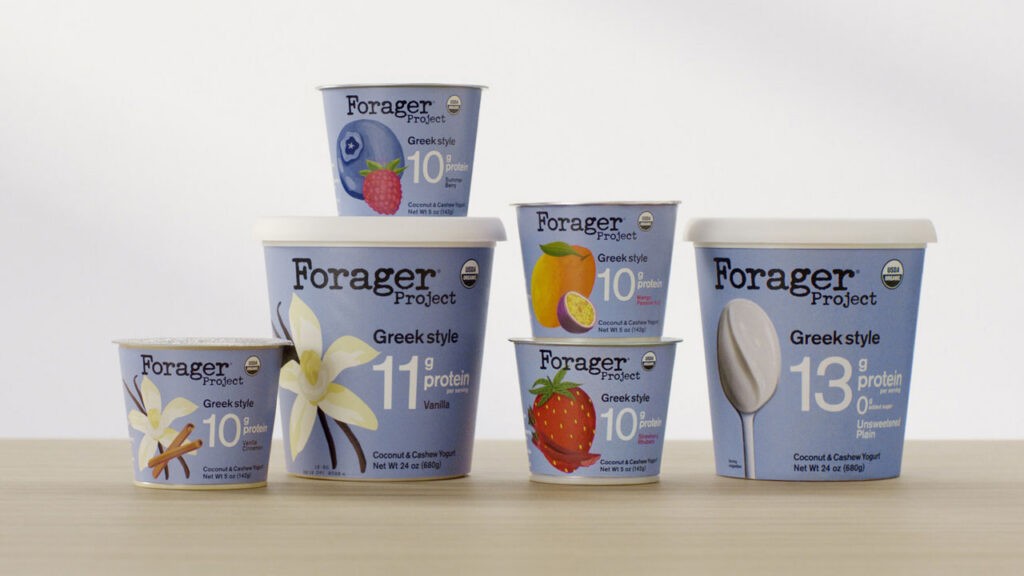
As part of my Design 121 class, we were tasked to reimagine how Forager Project, organic, family-owned plant-based creamery, appears in the lives of a specific user.
Year :
2026
Group members
Katie Small
Christian Pierre
Bruce Lam
Skills
Need-finding interview
Ideating
Rapid prototyping
Project Duration :
5 weeks
Problem :
After conducting our interviews, we realized that, for busy users who are always on a rush, snacks are not only about taste or nutrition necessarily. It is about their convenience and portability. Having to move around frequently or eat on the go, limits the types of food items they can take with them. Dairy products by nature are messy and difficult to bring along with you, and yet, they provide a good source of protein and nutrients.

Process :
Defined research goals
Identified the rights participants, dividing them into:
Super users
Mainstream users
Experts
Stakeholders
Wildcard/Suprise
Methods of research:
Interviews
Shop-along
Empathy exercises
Expert interviews
Shadowing
Interview questions
Warm-up (building rapport)
Discovery (Open-ended questions)
Wrap-up
Gathering key points from each interviews
Identifying stories from interviews
Identifying insights from interviews
Establishing users, their tension, frequency, current spend, scale, and opportunity
Asking how-might-we questions to help generate solutions
Ideation
Selection of idea based on originality, viability, and impact
Solution :
With our problem in mind, we asked ourselves: how might we reimagine plant based products to move with people through their day? Forager-on-the-go was our answer to that question. A product line designed to move with people throughout their day, from morning commutes to late afternoon games.

Forager-on-the-go: Car version
For young parents, during car trips with their children,
we introduce freeze dried yogurt bites that
contains ingredients for nausea remedy
such as lemon, ginger, and mint.

Forager-on-the-go: Lunch-box
version
For a snack during lunch time for young kids,
we present a yogurt jelly made with real fruit.
It is a mess-free and convenient snack to eat.

Forager-on-the-go: After school
snack version
For after-school snacks for parents and families, during car rides, we present yogurt lollipops which are a healthy but also sweet dairy snack option for kids.

Forager-on-the-go: Refreshing
dessert version
For parents who want to please their kids with a sweet and yummy snack, we present a yogurt popsicle which is a healthy and easily portable snack that does not need refrigeration.
REFLECTION
This project reinforced how important it is to deeply understand the people we are designing for before jumping into solutions. Throughout the process, I realized that without a clear understanding of users' daily routines, motivations, priorities, and pain points, it becomes incredibly difficult to create something that genuinely fits into their lives. A product can be visually appealing or technically impressive, but if it does not address a real need or align with existing behaviors, it is unlikely to be adopted or create meaningful value.
One of the biggest lessons I took away is that effective design begins with curiosity and empathy.
Observing people in their natural environments, understanding how they make decisions, and asking thoughtful questions often reveals insights that users themselves may not immediately articulate. These observations can uncover underlying needs, frustrations, and opportunities that would otherwise remain invisible.
This realization feels especially relevant in a world where AI makes it easier than ever to rapidly generate concepts, redesign interfaces, create branding, or produce high-fidelity prototypes within minutes. As the barriers to creating solutions continue to decrease, the true differentiator becomes the ability to identify the right problem in the first place. The most valuable skill is no longer simply making things, but understanding people deeply enough to make the right things