SPARKBOOK
For my CS147 class, I designed SparkBook, a digital notebook that allows artists to store multimedia sources of inspiration while smartly organizing them based on their chosen categories.
Year :
2025
Group members
Claire Birge
Elijah Anderson
Mikela Coseteng
Skills
Figma
User Research
User Interviews
Competitor Analysis
Heuristic Evaluation
Usability Testing
Project Duration :
10 weeks

Problem :
Through interviews with several different artists, we discovered that inspiration is highly fragmented. Artists lack a centralized and intuitive way to capture, organize, and retrieve diverse sources of inspiration. This fragmentation creates friction in their creative workflow, making it harder to access past references and transform moments of inspiration into finished artwork.
Process :
Needfinding: Initial research and user interviews to understand creative workflow challenges.
POVs, HMWs, and Experience Prototypes: POVs, HMWs, and experience prototypes to refine our understanding.
Concept Video: Video showcasing our initial concept and vision for SparkBook. Slides include information of our product values.
Low-Fi Prototyping & Testing: Sketching, low-fidelity prototypes, and usability testing results.
Medium-Fi Prototype: Interactive medium-fidelity prototype with detailed design specifications.
High-Fi Prototype: Polished, interactive high-fidelity prototype ready for user testing.
Heuristic Evaluation: Comprehensive usability evaluation using established heuristics.
Access our website to go through the entire process in more depth.
Solution :
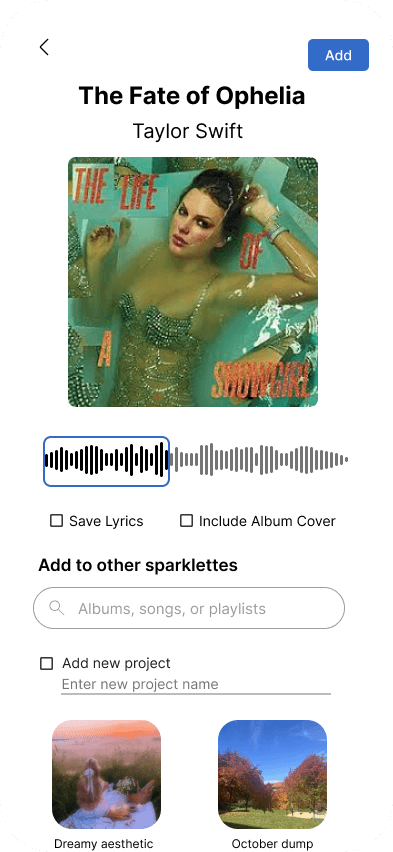
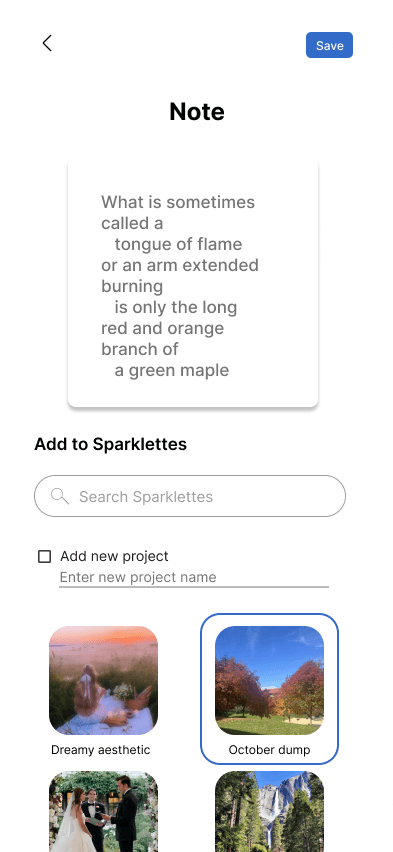
A digital notebook that allows artists to store multimedia sources of inspiration while smarty organizing them based on their chosen categories




REFLECTION
Going into the needfinding process with the skills and teachings provided to us was incredibly valuable. By not having a solution in mind and focusing on creating open-ended questions where artists could freely share their experiences and talk for most of the interview, was instrumental in helping us find a common thread and issue that these artists face. Additionally, by focusing on gathering as many varied users as possible, we were able to gain a richer understanding of each of their problems in various different lenses — helping us develop a solution that was as comprehensive as possible.
Having synthesized our findings, it was helpful to rapidly think of solutions based on the “How Might We’s” developed. With the POV’s created, allowing us to further empathize and understand each of the artists we interviewed, it allowed us to more easily develop solutions while still remaining grounded in the issues we identified. Not only this, but by framing the question as “how might we”, deviated judgement and allowed us to be more creative with our responses.
We also found it helpful that the iterative process of design was still implemented, even with the tight deadline. Receiving feedback from users in both the low and mid fidelity prototypes allowed us to consider gaps in our interface that we might have not previously noticed due to our inherent bias of having created the app and knowing what all of the functionalities are intended to do. Additionally, by getting feedback in the low-fidelity prototype, we were able to first ensure that the key functionalities within the app were strong and easy to use. In the low-fidelity prototype, users found that some features were hard to find such as the AI organization tool and that other features weren’t as intuitive, such as sharing their inspirations with the community. The feedback we received from the mid-fidelity prototype was also valuable, and allowed us to further focus on the flow, aesthetic, and consistency of the interface.